




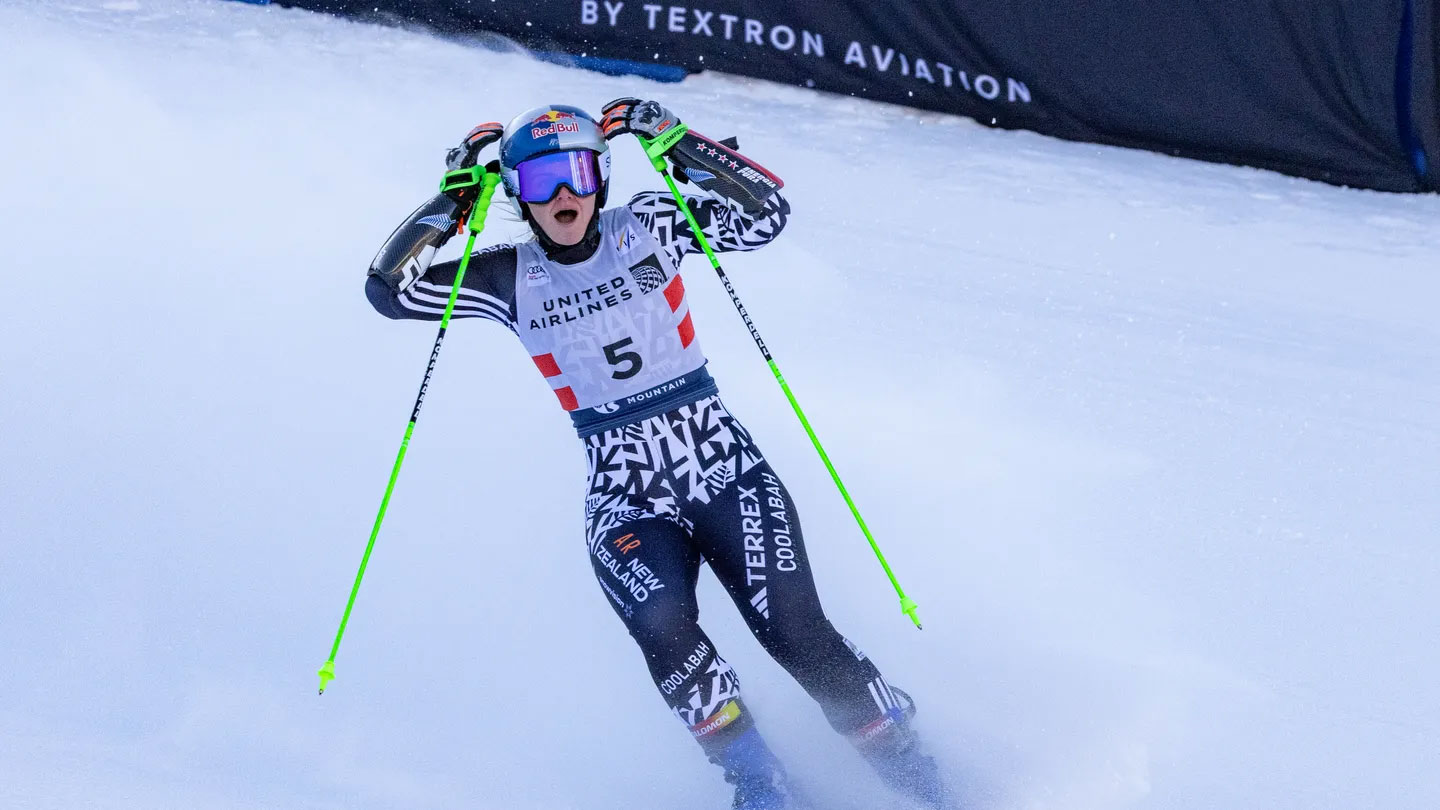
Not even feeling down on confidence and out of control on the slope could stop Alice Robinson (NZL/Salomon) from making history in Copper Mountain on Saturday.
Robinson dominated the Giant Slalom in the Colorado sunshine, posting the best first run and the equal-best second run to finish almost a second clear of the field, with Julia Scheib (AUT/Rossignol, +0.96s) and Thea Louise Stjernesund (NOR/Rossignol, +1.08s) rounding out the podium.
With her fifth World Cup victory, Robinson broke a tie with compatriot Claudia Riegler (NZL) to become the most successful women’s Alpine ski racer from outside Europe or North America.
“I didn’t know that, but that is pretty cool,” Robinson said of her history-making exploit.
“It’s always really special for me to represent New Zealand, especially in a sport like ski racing that’s so dominated by North America and Europe, so I’m really proud of that.”
A young veteran at 23, Robinson won her first World Cup race at just 17 and is coming off the most consistent season of her career, having led the World Cup GS tour last year with seven podiums from nine races.
But she only managed to convert one of those podiums into a victory, and a costly DNF at the World Cup finals handed the discipline Crystal Globe to Federica Brignone (ITA/Rossignol).
That disappointing end to last season spilled over into this year’s opener in Sölden, where Robinson finished eighth, a performance that dented her confidence but ultimately didn’t break her.
“I was really not feeling that confident coming into this race, so I’m really proud of myself that I just trusted my instinct and just skied how I wanted,” the Sydney-born skier said.
“I honestly felt pretty gutted about Sölden and I think in the past I’d always let prior poor performances affect my next performance, so I really wanted to prove it to myself today that, ‘OK, Sölden wasn’t great, but you can pick yourself up and ski. It doesn’t mean you aren’t going to ski well today.'”
And did she ever ski well, despite the soft track from overnight snow and the difficult elevation of over 3000m.
Fifth out of the start gate in the first run, Robinson set the tone with a dominant top section. Despite falling behind the ideal racing line at the top of the pitch mid-course, she fought back to regain the line and finished with a strong closeout to take a 0.29-second lead over Sara Hector (SWE/Head).
In the second run, starting with a 0.60-second lead after Hector had faltered to miss the podium, Robinson almost lost her balance early on but built on her lead throughout the course to win comfortably — although she didn’t know it.
“It was definitely a day of two different runs,” Robinson said. “The first run I felt so in control and so smooth and the second run just felt so out of control and I felt like I was just recovering the whole time, so I was pretty shocked to see the big green light in the finish.
Honestly, it was complete disbelief — I thought I blew it with the mistakes.
– Alice Robinson on seeing the green light in the finish area
That green light could have been even bigger had Scheib not recovered from almost being pitched out of the course at the top of her second run.
But the Sölden winner recovered to move up from third to second, giving the 27-year-old as many World Cup podiums early in the campaign as she had made in her entire career coming into this season.
Despite admitting that the conditions were “totally different” from Sölden and not suited to her, Scheib approached the race the only way she knew how.
“I pushed,” she said. “More in the second run, I pushed really hard.”
That allowed her to edge Stjernesund into third, after the Norwegian put down a blistering second run, matched only by Robinson.
“I had so high expectations for this day because I know what I have in me,” the 29-year-old said.
After toying with her ski set-up for the first run, Stjernesund was angry despite skiing into fifth place, describing it as “a Sunday trip, like we call it in Norway — you don’t do anything, you just ski.”
She changed her skis for the second run and it paid dividends as a dynamic performance vaulted her into the provisional lead and allowed her to leapfrog Hector (fourth) and Lena Duerr (GER/Head), who fell from fourth to sixth but still recorded her best career GS result.
“I was very happy that I dared to do that switch,” Stjernesund said. “For sure, it’s far from perfect, but I’m just so happy to see that it’s enough for a podium.”
Source: FIS Ski. Click here for full results from Saturday’s race.