Home/Article/RMBS default rates trending higher as house prices plunge
RMBS default rates trending higher as house prices plunge
By:
coolabahcap
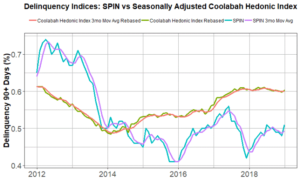
Coolabah developed the world’s first compositionally-adjusted, or hedonic, regression-based index of RMBS default rates, covering all prime deals that Bloomberg reports on (you can download the paper here). We update this index monthly, and the results are enclosed below.
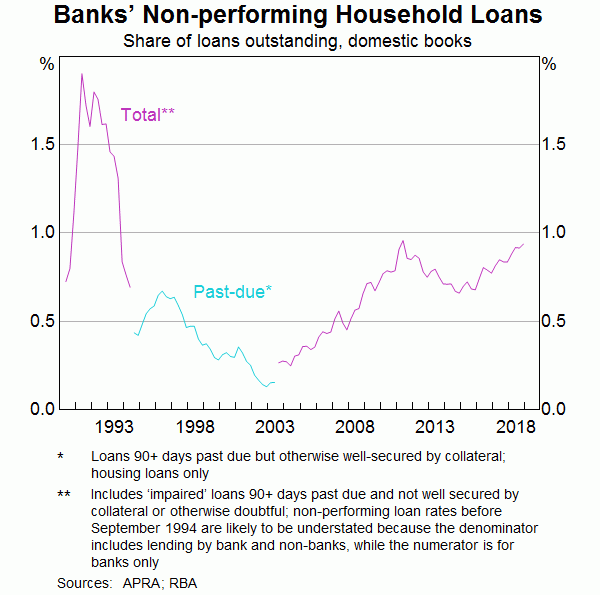
Contrary to S&P’s SPIN Index, we find that Aussie RMBS arrears (nb: legally there is no difference under home loan contracts between being in “default” and in “arrears”) have been steadily climbing since 2014. This is consistent with the RBA’s latest data on home loan default rates, which Governor Phil Lowe published during the week (see chart below). Observe that according to both the RBA and Coolabah’s indices, defaults have been rising for many years. In fact, Aussie RMBS arrears are approaching their GFC peaks.
At the same time, house prices are experiencing their biggest falls in 40 years (see Sydney chart below), which is particularly negative for RMBS because the only thing protecting the bond is the value of the home. This in turn means that leverage or the loan-to-value (LVR) ratios underpinning recently issued RMBS are likewise rising fast. When we model deals on a bond-by-bond basis we see big spikes in the share of borrowers with LVRs over 80% and 90% in deals issued since 2017.
Another significant negative for Aussie RMBS is that prepayment speeds are dropping like a stone (see our numbers below), which blows out the expected life of the bond and therefore reduces the expected credit spread an investor is earning relative to the spread they assumed when they bought the bond.
The deflation of the great Aussie housing bubble in an orderly fashion while the unemployment rate has fallen from 6.4% to 5.0%, GDP growth is demonstrably positive and higher than most OECD countries, the government’s budget is almost in balance, and the sovereign’s credit rating has been recently upgraded to AAA “stable”, is exceptionally positive from a financial stability perspective and credit positive for the banks on a medium term basis. This is because the banks have government-guaranteed funding via deposits, access to emergency RBA liquidity, and the prospect of government-guarantees of their senior bonds during crises. They are also constantly refinancing their home loan books with better quality assets written according to tighter lending standards. Finally, the Aussie banks in particular have slashed risk-weighted leverage in half since 2014 with the biggest build-up in equity capital in modern banking history as a result of APRA’s new “unquestionably strong” capital framework.
More News
Complexity Premia Podcast, Episode 76
Chris and Ying Yi unpack the Fed and RBA outlook, April portfolio performance, and where yields sit across fixed-income markets before turning to the escalating Iranian conflict and Australia’s 12 May Federal Budget. They assess how markets reacted, what the budget means for investors across housing, CGT and broader asset classes, and why Australia’s productivity problem, fiscal choices and capital flows could shape returns well beyond the next rate decision.
Chris and Ying Yi break down what rates markets are pricing in Australia and the US, and what that implies for housing, the Aussie dollar, and broader asset valuations. They assess the market impact of escalating conflict in Iran, where capital is flowing in periods of stress, and which assets are proving resilient. The discussion then turns to positioning—how to think about risk, where to hide, and where the most compelling opportunities are emerging in an increasingly volatile global environment.
Chris and Ying Yi challenge the Reserve Bank of Australia’s claim that policy is “close to balance,” arguing the data instead point to a persistent inflation problem driven by excessive fiscal spending, ultra-low unemployment, and years of overly easy monetary policy. They explain why the RBA may ultimately need to lift rates well above market expectations, why global inflation risks remain underpriced, and how AI capex, energy shocks, and Trump’s economic strategy could reinforce a higher-for-longer rate environment. The discussion concludes with the investment implications: avoid default risk, prioritise liquidity, and recognise why cash and high-quality bonds may now be among the most attractive assets available.
In this episode, Chris and Ying Yi run a top-down markets scan: recent performance and the outlook for yields, how hyperscaler AI capex is feeding into bond supply, inflation expectations and term premia, and where value is emerging across major asset classes. They cover the next moves from the RBA and the Fed, implications for housing and growth, and whether AI ultimately proves disinflationary. The conversation closes with the cross-asset tells—USD, gold and bitcoin—and what they’re signalling for the year ahead.
By clicking I confirm below, you confirm that you are an Australian resident, or will only access Fund Information as a unitholder in a Fund issued by Equity Trustees Limited, and you accept all of the Terms of Use of this website, which may be found here.
By clicking I confirm below, you confirm that you are a New Zealand resident, or will only access Fund Information as a unitholder in a Fund issued by Fund Rock NZ Limited, and you accept all of the Terms of Use of this website, which may be found here.
By clicking I confirm below, you confirm that you are a qualified / professional investor or equivalent in the United Kingdom or Europe. You also confirm that by accessing this website, you will not contravene, or cause Coolabah or any of its affiliates to contravene, any law that seeks to regulate financial promotions both in the country of your residence and in the country in which you are viewing this webpage and you accept all of the Terms of Use of this website, which may be found here.
By clicking I confirm below, you confirm that you are a qualified / professional investor or equivalent in the United States of America. You also confirm that by accessing this website, you will not contravene, or cause Coolabah or any of its affiliates to contravene, any law that seeks to regulate financial promotions both in the country of your residence and in the country in which you are viewing this webpage and you accept all of the Terms of Use of this website, which may be found here.
By clicking I confirm below, you confirm that you are a qualified / professional investor or equivalent in the relevant jurisdiction where the vehicle is permitted to be marketed to. You also confirm that by accessing this website, you will not contravene, or cause Coolabah or any of its affiliates to contravene, any law that seeks to regulate financial promotions both in the country of your residence and in the country in which you are viewing this webpage and you accept all of the Terms of Use of this website, which may be found here.