
Home / Article / A new hedonic approach to measuring mortgage default risk

A new hedonic approach to measuring mortgage default risk

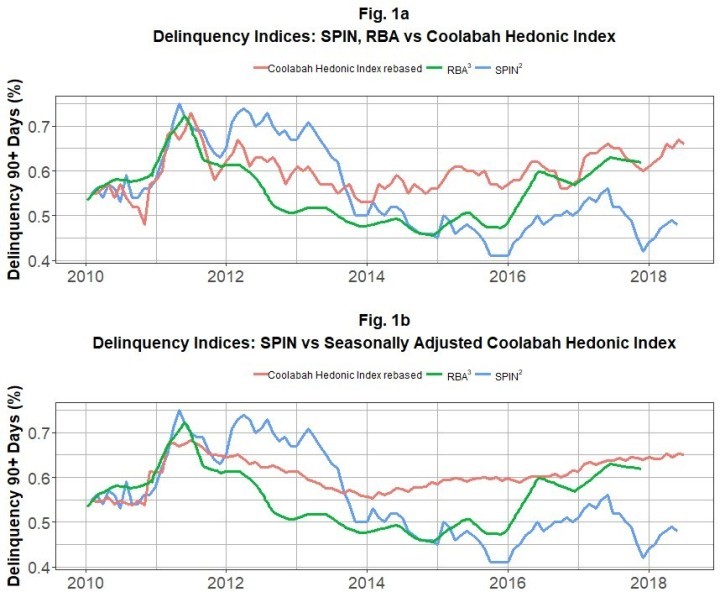
Measuring and monitoring the true level of mortgage delinquencies across an economy is essential for asset pricing and financial system stability. Yet public measures of mortgage default risk almost always use simple averages across pools of individual assets, including balance-sheet loans or indices tracking default risk across portfolios of residential mortgage-backed securities (RMBS). These approaches are, like median house price indices, afflicted by compositional biases that can lead to spurious inferences regarding the direction of default rates. Sources of bias include artificial changes in default rates attributable to: increases in the volume of new loans being written or securitised RMBS added to indices; changes in the proportion of transactions with higher loan-to-value ratios (LVRs); the introduction of less seasoned RMBS transactions with a lower weighted-average loan age; and/or borrower characteristics that have higher probabilities of default (e.g. tilts towards investment borrowers). To address this problem, we have developed the first known hedonic regression-based indices of mortgage default risk that explicitly control for compositional biases through the models’ characteristic-based independent variables. Whereas simple average measures of default rates across securitised loan portfolios have declined in recent years, which suggests that the risk of loss has been declining, our hedonic mortgage default index implies exactly the opposite: that is, compositionally-adjusted default rates have, in fact, been increasing sharply in recent times. Read the full paper here.
More News

Complexity Premia Podcast, Episode 76

Chris and Ying Yi unpack the Fed and RBA outlook, April portfolio performance, and where yields sit across fixed-income markets before turning to the escalating Iranian conflict and Australia’s 12 May Federal Budget. They assess how markets reacted, what the budget means for investors across housing, CGT and broader asset classes, and why Australia’s productivity problem, fiscal choices and capital flows could shape returns well beyond the next rate decision.

Complexity Premia Podcast, Episode 75

Chris and Ying Yi break down what rates markets are pricing in Australia and the US, and what that implies for housing, the Aussie dollar, and broader asset valuations. They assess the market impact of escalating conflict in Iran, where capital is flowing in periods of stress, and which assets are proving resilient. The discussion then turns to positioning—how to think about risk, where to hide, and where the most compelling opportunities are emerging in an increasingly volatile global environment.

Complexity Premia Podcast, Episode 74

Chris and Ying Yi challenge the Reserve Bank of Australia’s claim that policy is “close to balance,” arguing the data instead point to a persistent inflation problem driven by excessive fiscal spending, ultra-low unemployment, and years of overly easy monetary policy. They explain why the RBA may ultimately need to lift rates well above market expectations, why global inflation risks remain underpriced, and how AI capex, energy shocks, and Trump’s economic strategy could reinforce a higher-for-longer rate environment. The discussion concludes with the investment implications: avoid default risk, prioritise liquidity, and recognise why cash and high-quality bonds may now be among the most attractive assets available.

Complexity Premia Podcast, Episode 73

In this episode, Chris and Ying Yi run a top-down markets scan: recent performance and the outlook for yields, how hyperscaler AI capex is feeding into bond supply, inflation expectations and term premia, and where value is emerging across major asset classes. They cover the next moves from the RBA and the Fed, implications for housing and growth, and whether AI ultimately proves disinflationary. The conversation closes with the cross-asset tells—USD, gold and bitcoin—and what they’re signalling for the year ahead.
Scroll to Top
Scroll to Top