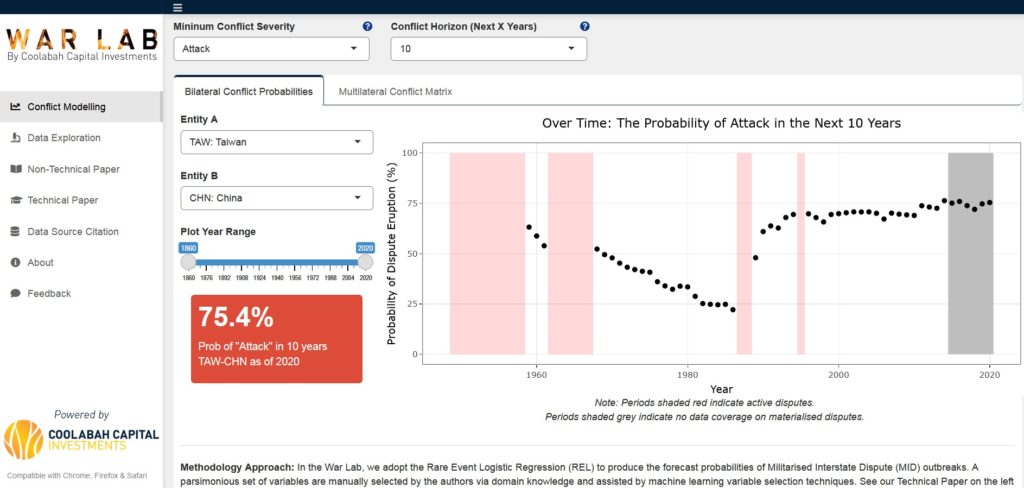
Writing for the Australian Strategic Policy Institute’s The Strategist today, Coolabah Capital Investments’ Chief Investment Officer Christopher Joye unveils Coolabah’s new War Lab (click here to view the War Lab), which houses advanced quantitative models for predicting future military conflicts around the world. In the article, Joye comments:
There’s a wealth of data on the history of military conflicts, which have caused many millions of deaths in the past century, but there’s comparatively little quantitative research forecasting the frequency and severity of wars.
As an investor in global financial markets, our firm is constantly grappling with the prediction business. Last year we created worldwide Covid-19 forecasting models that enabled us to anticipate a much earlier than expected peak in the first wave of infections in April 2020.
We have now developed research that can be used to assess the empirical likelihood of different types of conflicts occurring.
For the past decade, the biggest risk we have sought to understand is the spectre of war between the United States and China. The probability of such a conflict appears to have accelerated under the hardline presidency of Xi Jinping. Many experts, including John Lee, Oriana Skylar Mastro, Rory Medcalf and Ross Babbage, who consult to us, have put the risk of a lower-intensity conflict at around 50%.
Our quantitative research supports that.
A team of Kai Lin, Nathan Giang, James Yang and me has spent 12 months drawing on 160 years of conflict data and using a range of techniques to predict the probability of different types of conflicts of varying severity.
The goal of our research is to stimulate further academic study and inject greater objectivity into public debates about the risk of military conflicts. Such debates almost always involve highly subjective opinions that often lack a data-centric, evidentiary basis and empirical testing.
The conclusions focus on horizons of 12 months, five years and 10 years. This research, covering most countries, is outlined in a technical paper and a summary (both available here).
Military acts by a nation directed towards the government, officials, forces, property or territory of another state are known in the academic literature as ‘militarised interstate disputes’, or MIDs. In our forecasting models, we classify MIDs into increasing tiers of severity: a threat to use force; an actual use of force; an attack, clash or raid; and an all-out war with a minimum number of deaths.
To tackle the forecasting problem that warfare represents, we applied scientific, statistical and machine-learning techniques to data on MIDs.
Significantly, our research implies that the likelihood of a low-intensity military conflict between Taiwan and China over the next 10 years has trended higher over time towards a probability of around 75%.